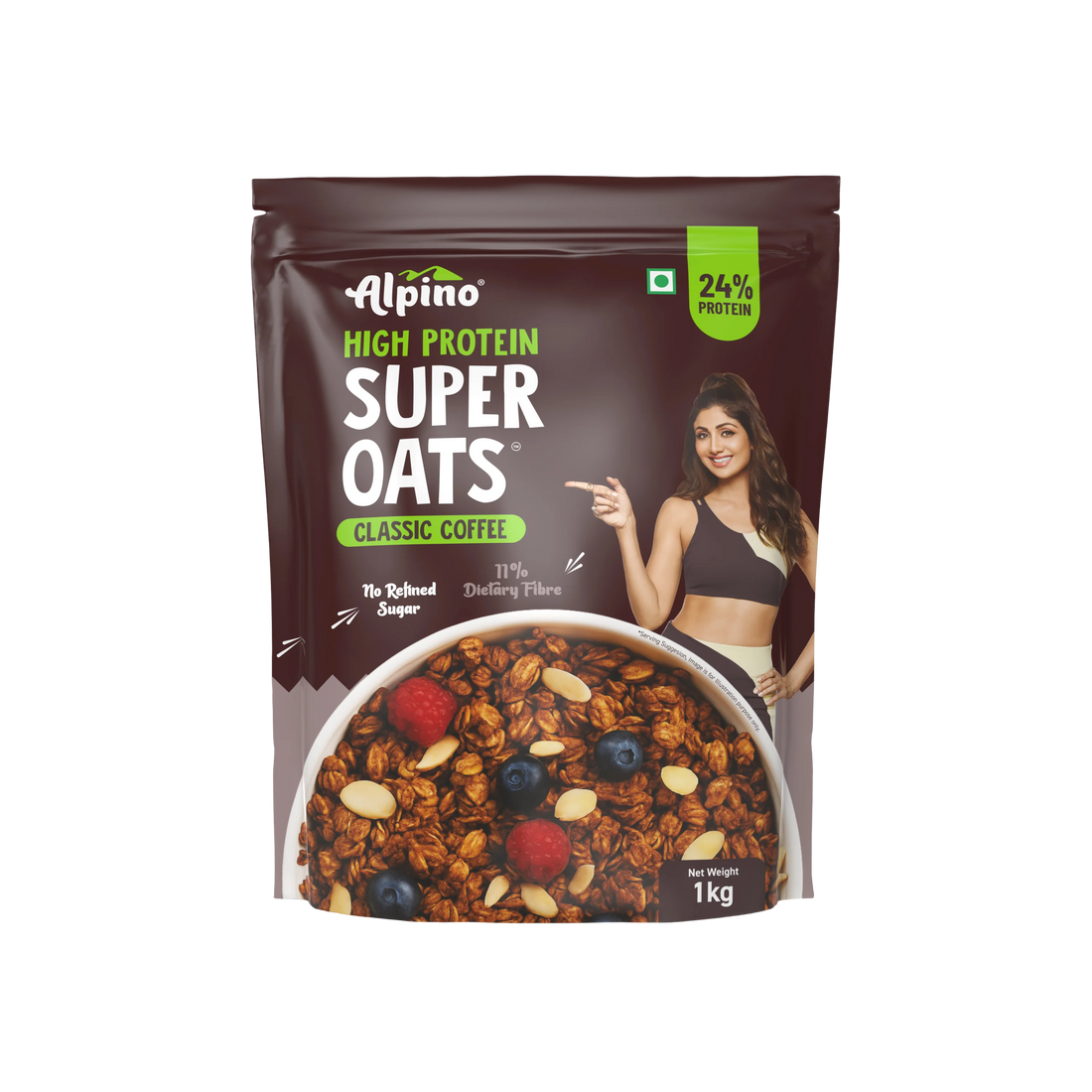


If you've been buying high protein oats thinking you're getting a solid protein-packed breakfast, you might want to take a closer look at the label. The high protein oats market in India has exploded in the last two years, and with it, a flood of products making big claims on the front of the pack that don't always hold up when you flip it around. Some deliver real, complete protein. Others are glorified flavored oats with a couple of grams of soy isolate sprinkled in. Knowing how to read the label is the difference between a breakfast that actually fuels your body and one that just sounds healthy.
Here are the 7 things you should check before putting any high protein oats in your cart.
Part 1: What to Check on the Label
1. Protein Percentage Per 100g
This is the non-negotiable number, and the first thing to look at. Standard rolled oats give you about 12-13g of protein per 100g. For a product to legitimately call itself "high protein oats," you want to see at least 20g of protein per 100g, ideally 22g and above.
Here's the catch most brands exploit: many advertise protein "per serving," not per 100g. A serving is typically 40-50g, which means a product claiming "25g protein per serving" might only be delivering that if you're eating a full 100g serving, not the 40g you're actually scooping into your bowl. Always check the per 100g column, not the per-serving column. That's the only apples-to-apples comparison across brands.
Anything below 18g per 100g and you're essentially paying a premium for regular oats with better packaging.
2. Protein Source Used: Does It Have a Complete Amino Acid Profile?
Not all protein is equal. This is the check most people skip, and it's arguably the most important one. Your body needs all 9 essential amino acids (EAAs) to build and repair muscle. A protein source is only considered "complete" if it contains all 9.
Here's why this matters for oats: oats themselves are not a complete protein, they're low in lysine. So the protein blend a brand adds to their oats determines whether your bowl is actually doing anything for muscle recovery, or just inflating the protein number.
What to look for on the label:
- Whey protein (whey concentrate or whey isolate), complete protein, high in BCAAs, excellent bioavailability
- Peanut protein, complete amino acid profile, plant-based, naturally rich in arginine and BCAAs
- Soy protein isolate- complete plant protein, PDCAAS score of 1.0
- Moong bean protein / pea protein- incomplete on their own; check if combined with another source
Red flag: if the only protein source listed is plain oats or a vague "plant protein blend" with no specifics, you have no way of knowing the amino acid profile. In that case, assume it's incomplete.
3. Added Sugar and Artificial Ingredients
A product can have 22g of protein per 100g and still be a poor breakfast choice if it's also carrying 15–18g of added sugar. Added sugar spikes insulin, drives energy crashes mid-morning, and quietly undoes the health benefit of the protein you just consumed.
Things to look for on the ingredient list:
- Refined sugar / white sugar, the worst kind, avoid outright
- Brown sugar / raw sugar, marginally better but still added sugar
- Organic jaggery, a natural sweetener, but still sugar; acceptable in small amounts
- Artificial flavours (also labelled as "nature-identical flavours"), chemically synthesised compounds that mimic natural flavours; not inherently dangerous but a sign of a more processed product
- Artificial sweeteners (sucralose, aspartame, acesulfame-K), some people tolerate these well, others don't; worth noting if you're sensitive
The gold standard: zero added sugar, sweetened only by the natural sugars from dried fruit or not sweetened at all, with real cocoa powder instead of artificial chocolate flavouring.
4. Fibre Content per 100g
Protein gets all the attention, but fibre is what makes a bowl of oats worth eating in the first place. Oats naturally contain beta-glucan, a soluble fibre that slows glucose absorption, supports gut health, lowers LDL cholesterol, and extends satiety. When manufacturers process oats heavily to mix in protein and flavour, this fibre structure often degrades.
The benchmark to look for: at least 6-8g of dietary fibre per 100g. Below 5g per 100g and the product has likely undergone processing that stripped the natural fibre content, or the oat percentage in the blend is too low to matter.
High fibre content works in synergy with protein, the two together are what keep you full until lunch, not just protein alone.
5. Serving Size vs Calories
This one requires a quick mental calculation, but it's worth it. Some brands use a 40g serving; others use 50g or even 75g. If you're comparing two products on protein alone and missing the serving size difference, you might think one is dramatically better than it actually is.
The calculation to do: divide the calories per serving by the serving size in grams. A reasonable high protein oats product should sit around 3.8-4.5 kcal per gram. If it's above 4.5 kcal/g and the protein is not proportionally high, you're getting extra calories from fat or sugar without the corresponding protein payoff.
Also watch out for products where the serving size is set unrealistically small- 30g, for example- to make the calorie count look lower than it is in a real-world portion.
6. Ingredient List Length - More Ingredients Means More Processing
This is the simplest and most underrated label check. Flip the pack and count the ingredients. A clean, minimally processed high protein oats should have 6-10 ingredients, all of which you can recognise and pronounce.
When you see a list that runs 20+ ingredients, with emulsifiers, stabilisers, anticaking agents, multiple artificial flavours, and three different forms of sugar, you're looking at a heavily processed food. The longer the list, the more the product has been stripped apart and rebuilt in a factory, which usually means more additives, more sodium, degraded fibre structure, and lower overall food quality.
The benchmark: under 10 ingredients, all recognisable, ideally whole foods. Rolled oats, peanut butter, cocoa powder, nuts, seeds, protein isolate, that's a clean label. Anything with more than two E-numbers warrants a closer look.
7. Sodium Content
This one flies under the radar for most buyers, but manufacturers add salt (often listed as Himalayan pink salt, which is still sodium) to enhance flavour, especially in chocolate-flavoured products. For breakfast food, the sodium should be minimal.
Target: under 200mg sodium per 100g. Above 300mg per 100g is high for a breakfast cereal, especially if you're also adding milk, which brings additional sodium. High sodium at breakfast contributes to daily totals that can push blood pressure over time and cause bloating.
Some products use pink salt as a marketing-friendly word for what is functionally still a high-sodium ingredient. The mineral trace differences between Himalayan pink salt and regular salt are negligible at the quantities used. Always check the actual mg number, not the ingredient name.
Part 2: The Best High Protein Oats in India - Rated on All 7 Parameters
Now that you know what to look for, here's how the top high protein oats brands in India stack up. Each product is rated on a scale of 1-5 across all 7 parameters, with 5 being the best possible score.
Rating Key: 5 = Excellent | 4 = Good | 3 = Average | 2 = Below average | 1 = Poor
|
Protein Oats |
Protein % (/5) |
Protein Source (/5) |
Added Sugar (/5) |
Fibre Content (/5) |
Serving vs Calories (/5) |
Ingredient List (/5) |
Sodium (/5) |
|
|
5 |
5 |
5 |
4 |
4 |
5 |
5 |
|
|
5 |
5 |
4 |
4 |
4 |
3 |
3 |
|
|
4 |
4 |
3 |
4 |
4 |
3 |
3 |
|
|
5 |
4 |
4 |
3 |
4 |
3 |
4 |
|
|
4 |
3 |
3 |
3 |
3 |
4 |
4 |


Why Alpino High Protein Super Oats Scores the Highest
Alpino's Super Oats is the only product in this list that derives its protein entirely from whole-food sources, rolled oats and natural peanut butter, with an added peanut protein isolate to bring the total to 22g per 100g. No texturised soy protein, no whey concentrate. Just real, recognisable ingredients.
The full ingredient list reads: Rolled Oats (61%), Unsweetened Peanut Butter (26%), Alpino Supernatural Peanut Protein, Cocoa Powder, Nuts & Seed Mix (Chia Seeds, Almonds, Raisins, Sunflower Seeds), Monk Fruit Extract. That's 7 ingredients. All of them are things you'd find in a kitchen, not a chemistry lab. Zero added sugar, zero artificial flavours, and zero salt, which is why it scores a 5 on sodium. The peanut protein used has a complete amino acid profile including all 9 essential amino acids and a strong BCAA content, making this genuinely effective for muscle repair, not just protein number inflation.
The fibre scores a 4 rather than a 5 only because the oat percentage (61%) is slightly lower than plain oats, but the nuts and seeds compensate with healthy fats. For anyone who wants high protein oats that are clean, complete, and made with the least number of processed ingredients of any product in this category, Alpino is the clear top pick.
Yogabar 26g High Protein Oats
Yogabar earns the highest raw protein score - 26g per 100g is genuinely the highest in this comparison, and it uses a complete protein blend of whey protein isolate and soy protein isolate, which together deliver a PDCAAS score of 1.0 (the maximum possible). It also adds probiotics for improved absorption, which is a smart functional addition.
Where it loses points is on the ingredient list and sodium. The product contains fructo-oligosaccharides, stevia glycosides, rice bran oil, and natural flavours, all safe, but the list is longer and more processed than Alpino's. Sodium comes in at around 230mg per 100g, which is on the higher side for a breakfast cereal. The added sugar score is a 4 (not 5) because the older SKU contains some natural sugars from dates and raisins that push total sugars higher than ideal.
For serious gym-goers who want maximum protein per gram, Yogabar is a strong contender. For anyone who prioritises clean ingredients and minimal processing, Alpino wins.
Pintola High Protein Oats
Pintola's Dark Chocolate variant comes in at 22g protein per 100g and uses a protein blend of texturised soy protein, soy protein isolate, and whey protein concentrate, a complete profile, but heavier on soy than most. The presence of organic jaggery is a genuine differentiator (natural sweetener vs refined sugar), but it still adds to the sugar load. The ingredient list includes Himalayan pink salt and sodium levels that are moderate but not minimal.
It scores a 4 on protein source quality instead of 5 because the primary protein delivery mechanism is texturised soy protein, which, while complete, is a heavily processed form of soy that's more similar to a filler ingredient than whole food protein. Decent overall, but not the cleanest option.
Dr. Choice Protein Oats
Dr. Choice is positioned as a lab-tested, no-nonsense protein oats with 27g of protein per 100g in its newer SKU, which, if accurate, is genuinely impressive. The ingredient profile includes jaggery (no refined sugar), no artificial flavours, and no palm oil, which are all positives. The sodium is low at around 68mg per 100g, earning it a 4 on that parameter.
The rating drops on the ingredient list because it contains a nature-identical chocolate flavour and an antioxidant (INS 307b, a form of Vitamin E that is safe but still an additive). The oats percentage is not disclosed on many retail listings, which makes it harder to verify the base quality. For the price-to-protein ratio, it's one of the better value options in this list.
True Elements High Protein Oats
True Elements differentiates itself by using moong bean protein isolate (14%) as its primary protein source, a plant-based, lactose-free choice that makes this the best option for strict vegans. The ingredient list is clean: oats, jaggery, moong bean protein isolate, cocoa, watermelon seeds, soy oil, almonds, chia seeds, dried blackcurrant, natural chocolate flavour, rosemary extract.
However, the protein tops out at 21g per 100g, and moong bean protein is not a complete protein on its own, it's low in methionine and cysteine. This is the main reason for the lower score on protein source quality. Combined with the use of jaggery (17% of the blend) and natural chocolate flavouring, it scores 3s in several categories. It's not a bad product, it's among the cleanest plant-based options, but if complete protein and muscle recovery are the priority, it falls short compared to blends that use whey or peanut protein.
Before You Buy, Consider This
Most high protein oats will tell you what they want you to hear on the front of the pack. The label on the back tells you the truth. Protein per 100g, the source behind that protein, and how many ingredients it took to get there, that's your three-point filter. Use it every time.
This article is for informational purposes only. Nutritional data sourced from brand websites, Amazon product listings, and Open Food Facts. Always read the label of the specific SKU you purchase, as formulations may vary between flavours and pack sizes.